

What is Bend Testing?
Bend testing is a mechanical test used to evaluate the ductility, strength, and surface integrity of materials by applying a controlled bending load. The test determines how a material deforms when bent around a defined radius or mandrel and identifies cracking, fracture, or other defects that occur during deformation.
This testing method is commonly used to assess material quality, heat treatment effectiveness, and weld soundness. Bend testing provides a simple and effective means of identifying surface discontinuities, lack of fusion, or brittleness that may not be evident through tensile testing alone.
Bend testing is applicable to metals, alloys, plate, bar, sheet, tubing, and welded joints. It is widely used across aerospace, construction, automotive, energy, industrial manufacturing, and pressure vessel applications. Bend test results support material acceptance, process qualification, and quality control requirements.
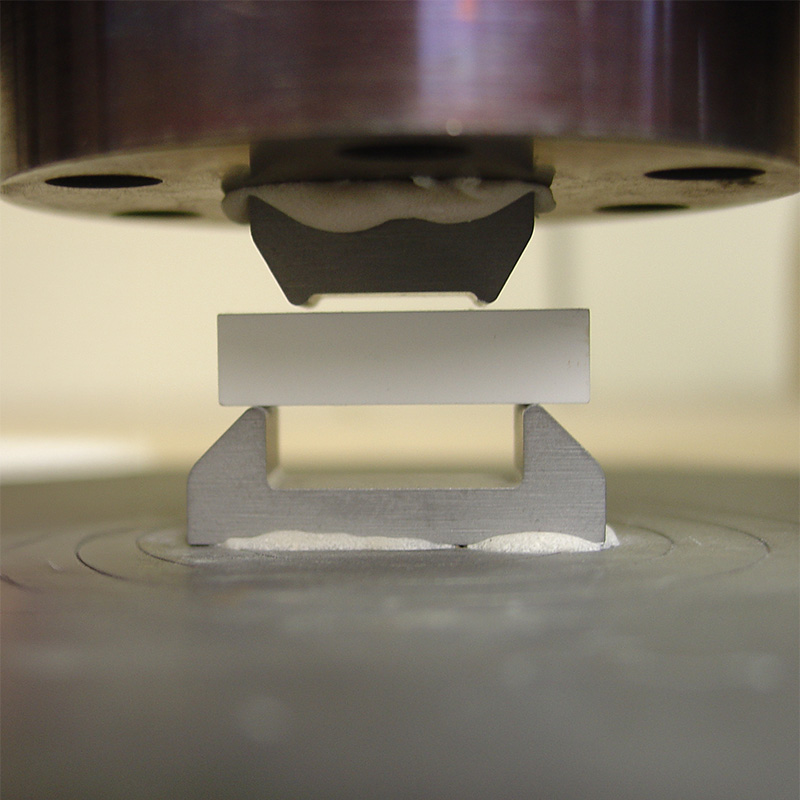
How Bend Testing Works
Specimen Preparation and Fixture Selection
Specimens are prepared according to applicable standards or customer requirements, with dimensions and orientation documented. Appropriate bend fixtures, such as mandrels, rollers, or supports are selected based on material thickness and test type. Alignment is verified to ensure consistent loading.
Controlled Bending Application
A bending force is applied at a defined rate until a specified bend angle, bend radius, or displacement is achieved. Tests may be conducted as guided bend, free bend, or wrap-around bend, depending on objectives. Deformation behavior and surface condition are monitored throughout the test.
Inspection and Reporting
After bending, specimens are visually inspected for cracking, tearing, or surface defects. Bend angle, radius, and observed damage are recorded. Results are documented in a test certificate.
Key Benefits of Bend Testing
Bend testing provides a direct method for evaluating ductility and surface quality without complex instrumentation. It supports material qualification and process verification through observable deformation behavior.
- Evaluates material ductility and formability
- Identifies surface cracks and discontinuities
- Verifies weld quality and fusion integrity
- Supports heat treatment and process qualification
- Confirms compliance with acceptance requirements
Frequently Asked Questions
What specific material properties does bend testing evaluate that tensile testing does not?
Bend testing primarily evaluates ductility, surface integrity, and resistance to cracking under localized tensile strain on the outer bend surface. Unlike tensile testing, which distributes strain uniformly along a gauge length, bend testing concentrates strain at the bend radius. This makes it especially effective at revealing surface defects, inclusions, lack of fusion in welds, and brittle behavior caused by improper heat treatment or material condition. Bend testing is therefore often used as a supplemental acceptance test rather than a strength characterization method.
How is bend radius selected for a bend test?
Bend radius is selected based on material thickness, material type, and applicable standards or customer requirements. Many specifications define minimum bend radius values to represent acceptable formability without cracking. Smaller bend radii impose higher surface strain and are used to evaluate ductility limits. The selected radius directly affects test severity and must be controlled and documented to ensure repeatable and interpretable results.
What types of defects are commonly revealed during bend testing?
Bend testing commonly reveals surface cracks, microcracks, laminations, inclusions, lack of fusion in welds, undercut, and embrittlement. These defects become visible on the tension side of the bend as the material deforms. Because the test creates high localized strain, even small discontinuities that may not affect tensile strength can become critical under bending conditions.
Why is bend testing commonly used for weld qualification?
Bend testing is widely used for weld qualification because it directly evaluates weld metal and heat-affected zone ductility under severe deformation. When a welded specimen is bent, any lack of fusion, slag inclusions, or brittle microstructures are exposed as surface cracking. This makes bend testing a reliable and visually clear method for qualifying weld procedures and verifying welder performance.
How are bend testing results evaluated and documented?
Results are evaluated through visual inspection of the bent specimen in accordance with defined acceptance criteria. Cracks, tears, or other surface discontinuities are measured and compared to allowable limits. Bend angle, bend radius, specimen orientation, and observed defects are documented in a formal test report.
Client Testimonials
Nick Kattamis – Creare
I wanted to extend a very big THANK YOU for prioritizing this work and helping it get done so quickly. Often times these last minute requests are out of our hands, so again, thank you for your responsiveness.
Ryan Canfield
I’d like to thank Innovative Test Solutions for their excellent work, and for accommodating our second round of testing. This was an important milestone for us, and we will definitely remember you for future needs.
Kris – GE Power
Excellent work on this testing and report write up! As usual, the ITS team exceeded expectations.
Earl Size
Thank you very much! And thank you for going the extra mile in helping us where you thought to. I truly appreciate it.
Richard F. – Chromalloy
The efforts on the erosion test program were excellent. Kyle and Jason did an outstanding job. We were working with many unknowns. Both men made major contributions that resulted in a successful outcome. I now feel confident that we have the recipe to conduct side-by-side erosion tests of coatings on actual parts. I anticipate that we will use the erosion test methodology again in the latter part of 2019. Thanks for your assistance.
Adam – Curtiss Wright
Thank you all for all of your efforts with this program. I have worked with many test labs over the years and must say that you were one of the best I have come across. The responsiveness and willingness to work with us to find a good solution was unprecedented with previous experiences with other facilities. Thank you all for being great to work with.
Recent Posts

How Fatigue Testing Can Prevent Costly Failures in Critical Industries
Fatigue testing does so much more than simply predict product failure. It also helps refine designs and provide valuable insight into material properties and behaviors to support safety and reliability. Many industries rely on rigorous…

Exploring JETS Testing: Key to Aerospace Safety and Efficiency
Exploring JETS Testing: Key to Aerospace Safety and Efficiency The aerospace industry solves some of the most complex issues faced by modern society. This sector has always pushed beyond the limits of what is possible…

High-Cycle Fatigue vs. Low-Cycle Fatigue Testing
Introduction to Fatigue Testing Fatigue refers to the gradual formation of microcracks and cracks in a material under the cyclic loading of stress. Those irregularities reduce the material’s capacity to withstand cyclic loads and ultimately lead…
Speak With A Professional Today
Make an Inquiry or Request a Quote and our team will be in touch.