

What is Fatigue Testing?
Fatigue testing evaluates how materials and components degrade over time when exposed to repeated loading rather than a single, static force. Many failures occur well below a material’s maximum strength due to microscopic crack initiation and growth caused by cyclic stress. Fatigue testing isolates this behavior to determine when and how failure begins.
At ITS, fatigue testing is used to establish fatigue life, identify crack initiation thresholds, and compare performance between materials, designs, or manufacturing methods. Results support engineering decisions related to safety margins, inspection intervals, and design validation. This data is especially critical for components exposed to vibration, rotation, or fluctuating loads in long-term service.
By revealing failure mechanisms that are not visible through static testing, fatigue testing provides insight that helps engineers prevent premature failure, improve durability, and validate designs intended for extended operational use.
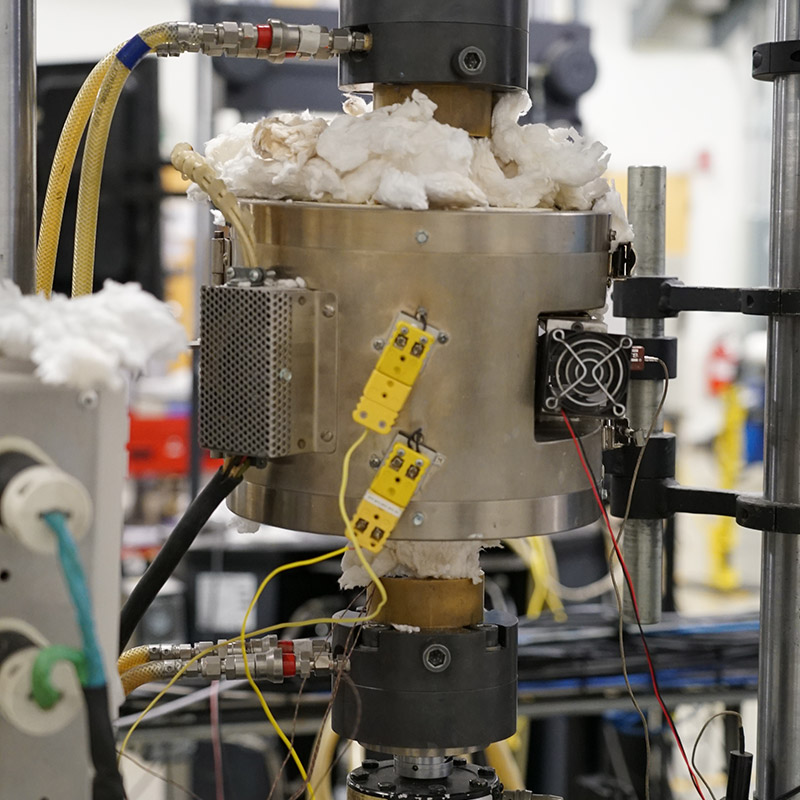
How Fatigue Testing Works
Fatigue testing involves subjecting a material or component to cyclic loading, where forces are applied repeatedly over time. The test measures how many cycles the material can withstand before failure occurs. Although ITS can customize mechanical testing services as needed, fatigue testing typically involves these five steps.
Specimen Preparation and Loading
ITS will customize methodologies and procedures for each specific product and material to ensure the highest quality result is achieved.
Determine the Load
Depending on the material and use-case, the team will determine the appropriate load and number of cycles for the test.
Run the Test
The servo-hydraulic testing machine will operate for the number of cycles determined or until sample failure.
Review the Results
ITS’ digitally controlled servo-hydraulic test frames are outfitted with state-of-the-art fixturing and data acquisition systems for data-driven insights.
Key Benefits of Fatigue Testing
Fatigue testing is crucial in many industries, including aerospace, automotive, manufacturing, and energy. Materials and components in real-world applications are often subjected to repeated stresses, even at levels lower than their maximum strength. Fatigue testing reveals their ability to withstand those stresses, also resulting in the following:
- Helping designers and manufacturers understand how materials will perform
- Ensuring product longevity, reliability, and safety
- Aiding industries in meeting industry standards and safety regulations
- Improving product design by identifying potential failure points
- Helping reduce maintenance and repair costs by preventing unexpected failures
- Minimizing unplanned downtime
Frequently Asked Questions
What conditions can ITS run fatigue testing in?
ITS performs fatigue testing in load or strain control at frequencies as low as a few per minute or one cycle per second. Our ISO/IEC 17025 accredited lab runs testing in various conditions, making it possible to simulate operating environments for many critical components and materials. The ITS team of expert engineers can also design custom tests or testing rigs to meet specific, unique needs.
What’s the difference between low-cycle and high-cycle fatigue testing?
- The three main differences between low-cycle and high-cycle testing are the frequencies, number of cycles, and stress levels. In low-cycle fatigue testing, samples get tested using stress levels above the material’s yield strength using low frequencies from 0.25 Hz to approximately 5 Hz. For these tests, the number of cycles does not exceed 100,000.
- In high-cycle fatigue testing, the sample undergoes testing at stress levels below the material’s yield strength. Frequencies typically range from 20 Hz to 60 Hz, depending on the material and intended environmental conditions. High-cycle testing is force-controlled and can run for more than one million cycles.
Are there special machining standards for fatigue specimens?
Yes, there are fatigue testing principles and standards that ensure the data can be compared, reproduced, and correlated from lab to lab. ITS tests according to ASTM standards E-466 and E-606. These standards provide detailed guidelines on specimen dimensions and the number of cycles and frequency ranges for each type of fatigue test. The standards also allow for a range of acceptable temperatures from sub-ambient to 2,000+ degrees Fahrenheit.
Can sub-mini specimens be used for fatigue testing?
- Yes, sub-mini specimens can be used. ITS’ innovative methods do just that. The team can perform sub-miniature sample testing using standard ratios and scaling down to accommodate the materials at hand. Additionally, we designed an adaptable grip system that allows sub-miniature samples to be installed in the standard frame of a servo-hydraulic machine.
- Fatigue testing provides critical data and insights that can enhance safety, reliability, and longevity. It’s useful in various industries but is particularly important in the aviation, aerospace, and automotive sectors. If you want more details or are ready to schedule a test, contact us to request a quote or discuss your project.
Client Testimonials
Nick Kattamis – Creare
I wanted to extend a very big THANK YOU for prioritizing this work and helping it get done so quickly. Often times these last minute requests are out of our hands, so again, thank you for your responsiveness.
Ryan Canfield
I’d like to thank Innovative Test Solutions for their excellent work, and for accommodating our second round of testing. This was an important milestone for us, and we will definitely remember you for future needs.
Kris – GE Power
Excellent work on this testing and report write up! As usual, the ITS team exceeded expectations.
Earl Size
Thank you very much! And thank you for going the extra mile in helping us where you thought to. I truly appreciate it.
Richard F. – Chromalloy
The efforts on the erosion test program were excellent. Kyle and Jason did an outstanding job. We were working with many unknowns. Both men made major contributions that resulted in a successful outcome. I now feel confident that we have the recipe to conduct side-by-side erosion tests of coatings on actual parts. I anticipate that we will use the erosion test methodology again in the latter part of 2019. Thanks for your assistance.
Adam – Curtiss Wright
Thank you all for all of your efforts with this program. I have worked with many test labs over the years and must say that you were one of the best I have come across. The responsiveness and willingness to work with us to find a good solution was unprecedented with previous experiences with other facilities. Thank you all for being great to work with.
Recent Posts

How Fatigue Testing Can Prevent Costly Failures in Critical Industries
Fatigue testing does so much more than simply predict product failure. It also helps refine designs and provide valuable insight into material properties and behaviors to support safety and reliability. Many industries rely on rigorous…

Exploring JETS Testing: Key to Aerospace Safety and Efficiency
Exploring JETS Testing: Key to Aerospace Safety and Efficiency The aerospace industry solves some of the most complex issues faced by modern society. This sector has always pushed beyond the limits of what is possible…
High-Cycle Fatigue vs. Low-Cycle Fatigue Testing
Introduction to Fatigue Testing Fatigue refers to the gradual formation of microcracks and cracks in a material under the cyclic loading of stress. Those irregularities reduce the material’s capacity to withstand cyclic loads and ultimately lead…
Speak With A Professional Today
Make an Inquiry or Request a Quote and our team will be in touch.