

What is Tensile Testing?
Tensile tests, sometimes called “tension tests,” are a type of mechanical test that involves applying a pulling force to the sample. The goal is to measure the strength of the material and amount of elongation it undergoes.
Tensile testing provides a wealth of data on material behavior and properties. In addition to determining the point of breaking or failure, this test also measures properties such as modulus of elasticity, yield strength, and strains.
How Tensile Testing Works
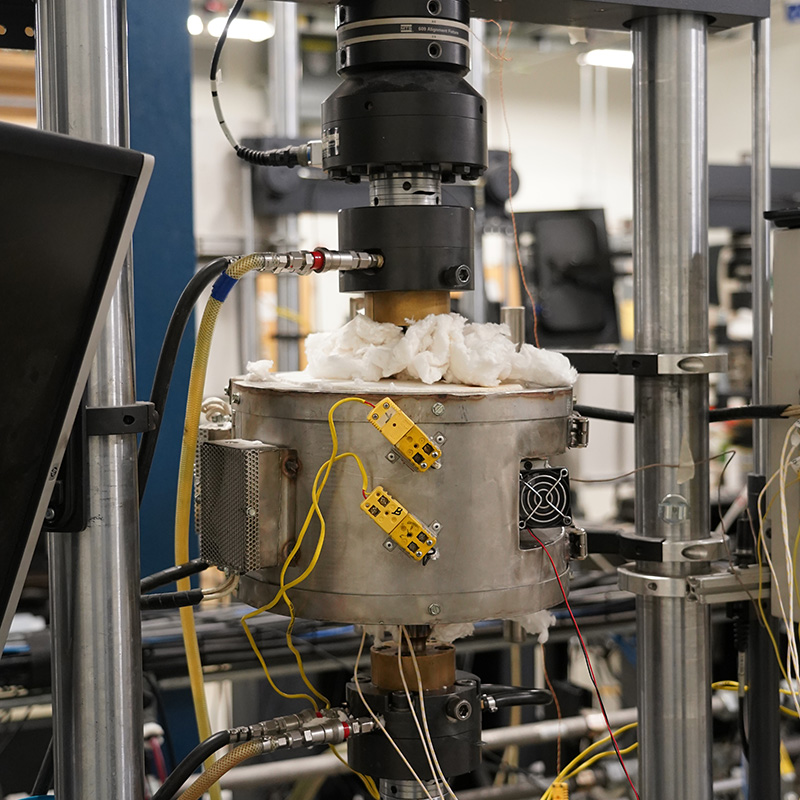
ITS uses state-of-the-art tensile test equipment to perform tensile testing for comparison to ASTM Standards. This allows ITS to report the maximum elongation and strength, as well as the reduced area of the tested material.
Specimen Preparation and Alignment
Test specimens are machined or selected according to applicable standards or customer specifications. Dimensions, gauge length, and cross section are measured and documented. Specimens are installed in calibrated grips, and alignment is verified to ensure axial loading and prevent bending effects.
Controlled Tensile Loading
A uniaxial tensile load is applied at a specified crosshead speed or strain rate. Force and elongation are continuously recorded throughout elastic and plastic deformation. Testing continues until yield, fracture, or a defined proof load is reached, depending on test objectives.
Data Analysis and Reporting
Stress strain data is analyzed to determine tensile strength, yield strength, elongation, and reduction of area. Fracture location and failure mode are documented. Results are delivered in a formal test report including measured values, and resulting calculated data.
Key Benefits of Tensile Testing
Tensile testing delivers precise data on how materials perform under tension, helping manufacturers validate strength, ensure compliance, and improve product reliability before materials are placed into service.
- Verifies material strength and key tensile properties
- Ensures compliance with ASTM and applicable industry standards
- Identifies yield, elongation, and fracture behavior
- Improves product safety and reliability
- Supports design optimization and material development decisions
- Reduces risk by detecting weakness early in development
Frequently Asked Questions
What environmental conditions can tensile testing be performed in?
Environmental factors, including temperature, can have an impact on tensile properties. ITS tensile testing services simulate real-world operating environments. Our testing equipment can produce temperatures ranging from -320 degrees Fahrenheit to 2,000 degrees Fahrenheit.
Can Poisson’s Ratio be determined in a standard tensile test?
Yes, Poisson’s ratio can be measured during tensile testing as an additional test. It describes the material’s expansion along one axis and contraction along the opposite one as the sample is exposed to tensile forces.
ITS also determines the following related properties:
- Young’s Modulus: The measurement of the ability of a material to withstand changes in length while under tension or compression.
- Yield Strength: The stress a material can withstand without permanent deformation.
- Elongation: The amount of extension an object or material under tension or stress can withstand.
What is the difference between a proof load test and a tensile test?
Instead of stressing the specimen to failure, as tensile tests do, proof load tests confirm materials can support the specified load. For example, a proof load test would subject a sample to a specified load to confirm its quality and ability to perform without permanent deformation.
What are the benefits of choosing ITS for tensile testing?
Today’s technological demands require tensile testing to be performed using precision instrumentation and within a range of environmental settings. ITS has more than 30 digitally controlled servo-hydraulic test frames. Each has the capability to perform tensile testing over a wide range of temperatures in air or inert gas environments. Additionally, our frames are outfitted with state-of-the-art fixturing and data acquisition systems.
Client Testimonials
Nick Kattamis – Creare
I wanted to extend a very big THANK YOU for prioritizing this work and helping it get done so quickly. Often times these last minute requests are out of our hands, so again, thank you for your responsiveness.
Ryan Canfield
I’d like to thank Innovative Test Solutions for their excellent work, and for accommodating our second round of testing. This was an important milestone for us, and we will definitely remember you for future needs.
Kris – GE Power
Excellent work on this testing and report write up! As usual, the ITS team exceeded expectations.
Earl Size
Thank you very much! And thank you for going the extra mile in helping us where you thought to. I truly appreciate it.
Richard F. – Chromalloy
The efforts on the erosion test program were excellent. Kyle and Jason did an outstanding job. We were working with many unknowns. Both men made major contributions that resulted in a successful outcome. I now feel confident that we have the recipe to conduct side-by-side erosion tests of coatings on actual parts. I anticipate that we will use the erosion test methodology again in the latter part of 2019. Thanks for your assistance.
Adam – Curtiss Wright
Thank you all for all of your efforts with this program. I have worked with many test labs over the years and must say that you were one of the best I have come across. The responsiveness and willingness to work with us to find a good solution was unprecedented with previous experiences with other facilities. Thank you all for being great to work with.
Recent Posts

How Fatigue Testing Can Prevent Costly Failures in Critical Industries
Fatigue testing does so much more than simply predict product failure. It also helps refine designs and provide valuable insight into material properties and behaviors to support safety and reliability. Many industries rely on rigorous…

Exploring JETS Testing: Key to Aerospace Safety and Efficiency
Exploring JETS Testing: Key to Aerospace Safety and Efficiency The aerospace industry solves some of the most complex issues faced by modern society. This sector has always pushed beyond the limits of what is possible…
High-Cycle Fatigue vs. Low-Cycle Fatigue Testing
Introduction to Fatigue Testing Fatigue refers to the gradual formation of microcracks and cracks in a material under the cyclic loading of stress. Those irregularities reduce the material’s capacity to withstand cyclic loads and ultimately lead…
Speak With A Professional Today
Make an Inquiry or Request a Quote and our team will be in touch.