

What is Vibration Testing?
Vibration testing is a mechanical evaluation method used to assess how materials, components, and assemblies perform when subjected to dynamic vibration environments. The test simulates real world operating conditions such as transportation loads, machinery induced vibration, or in service dynamic excitation.
This testing identifies resonance frequencies, fatigue sensitive regions, loosened fasteners, structural degradation, and potential failure mechanisms caused by repeated cyclic motion. Vibration testing is commonly used during design validation, qualification testing, and failure investigation to confirm durability and structural integrity.
Vibration testing is applicable to metals, composites, electronics, mechanical assemblies, welded structures, fasteners, and packaged systems. Industries that rely on vibration testing include aerospace, automotive, defense, electronics, industrial equipment, energy, and transportation. Test data supports design improvements, reliability assessments, and compliance with customer or industry requirements.
How Vibration Testing Works
Test Setup and Instrumentation
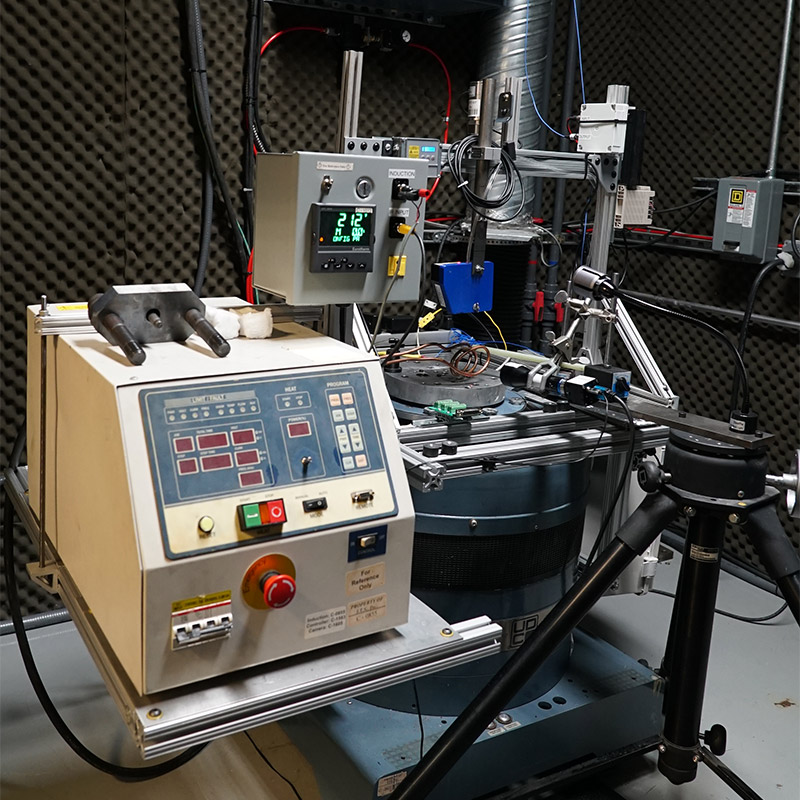
Test objectives, vibration profiles, and acceptance criteria are defined based on service conditions or applicable standards. Components are mounted to vibration tables using fixtures that replicate real mounting conditions. Accelerometers and sensors are installed to measure response and verify input levels.
Controlled Vibration Excitation
Vibration is applied using electrodynamic or mechanical shakers in sinusoidal, random, or swept frequency profiles. Amplitude, frequency range, and duration are controlled and monitored. Data is captured to identify resonant frequencies, and response amplification.
Evaluation and Reporting
After testing, components are inspected for structural damage, loosening, cracking, or performance degradation. Vibration response data is analyzed and compared to acceptance criteria. Results are documented including test profiles, measurements, and captured data.
Key Benefits of Vibration Testing
Vibration testing supports reliable product design by identifying dynamic weaknesses before field exposure. It reduces risk by validating durability under realistic operating conditions.
- Identifies resonance frequencies and amplification risks
- Evaluates fatigue behavior under dynamic loading
- Supports transportation and operational durability assessment
- Reduces risk of vibration induced failure
Frequently Asked Questions
What types of vibration profiles are used in vibration testing?
Common vibration profiles include sinusoidal vibration for resonance identification, random vibration for simulating broad spectrum environments, and swept sine testing for frequency response analysis. Profile selection depends on service conditions, industry standards, and test objectives. Multiple profiles may be combined to replicate real world vibration exposure.
How is resonance identified during vibration testing?
Resonance is identified by monitoring the response of the test article relative to the input vibration. Peaks in acceleration or displacement indicate natural frequencies where amplification occurs.
Can vibration testing be combined with other environmental conditions?
Yes. Vibration testing can be performed alongside thermal exposure or environmental conditioning to evaluate combined effects. This approach is commonly used for aerospace, electronics, and defense applications where components experience vibration and temperature simultaneously during service.
What standards are commonly used for vibration testing?
Vibration testing may be performed in accordance with standards such as ASTM, MIL STD, ISO, and customer specific specifications. Standards define vibration profiles, test durations, acceptance criteria, and instrumentation requirements to ensure repeatable and meaningful results.
How are vibration testing results used in engineering decisions?
Results are used to validate design robustness, identify fatigue risks, support qualification requirements, and guide design improvements. Vibration data also supports failure analysis and helps define safe operating limits and maintenance intervals for vibration sensitive components.
Client Testimonials
Nick Kattamis – Creare
I wanted to extend a very big THANK YOU for prioritizing this work and helping it get done so quickly. Often times these last minute requests are out of our hands, so again, thank you for your responsiveness.
Ryan Canfield
I’d like to thank Innovative Test Solutions for their excellent work, and for accommodating our second round of testing. This was an important milestone for us, and we will definitely remember you for future needs.
Kris – GE Power
Excellent work on this testing and report write up! As usual, the ITS team exceeded expectations.
Earl Size
Thank you very much! And thank you for going the extra mile in helping us where you thought to. I truly appreciate it.
Richard F. – Chromalloy
The efforts on the erosion test program were excellent. Kyle and Jason did an outstanding job. We were working with many unknowns. Both men made major contributions that resulted in a successful outcome. I now feel confident that we have the recipe to conduct side-by-side erosion tests of coatings on actual parts. I anticipate that we will use the erosion test methodology again in the latter part of 2019. Thanks for your assistance.
Adam – Curtiss Wright
Thank you all for all of your efforts with this program. I have worked with many test labs over the years and must say that you were one of the best I have come across. The responsiveness and willingness to work with us to find a good solution was unprecedented with previous experiences with other facilities. Thank you all for being great to work with.
Recent Posts

How Fatigue Testing Can Prevent Costly Failures in Critical Industries
Fatigue testing does so much more than simply predict product failure. It also helps refine designs and provide valuable insight into material properties and behaviors to support safety and reliability. Many industries rely on rigorous…

Exploring JETS Testing: Key to Aerospace Safety and Efficiency
Exploring JETS Testing: Key to Aerospace Safety and Efficiency The aerospace industry solves some of the most complex issues faced by modern society. This sector has always pushed beyond the limits of what is possible…
High-Cycle Fatigue vs. Low-Cycle Fatigue Testing
Introduction to Fatigue Testing Fatigue refers to the gradual formation of microcracks and cracks in a material under the cyclic loading of stress. Those irregularities reduce the material’s capacity to withstand cyclic loads and ultimately lead…
Speak With A Professional Today
Make an Inquiry or Request a Quote and our team will be in touch.