

What is Vibration Modal Analysis?
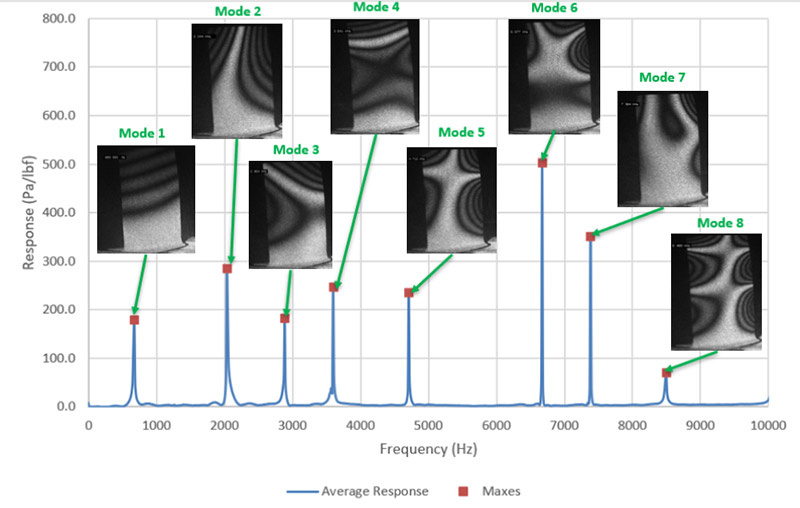
Vibration modal analysis is a mechanical testing method used to characterize the dynamic properties of a structure or component, including natural frequencies, mode shapes, and damping ratios. The test determines how a system vibrates when excited and identifies resonance conditions that can lead to excessive stress, noise, or fatigue.
This analysis is used to validate analytical models, support design optimization, and diagnose vibration-related issues. By understanding modal behavior, engineers can predict how structures will respond to operational loads and modify designs to avoid resonance within operating frequency ranges.
Vibration modal analysis is applicable to metals, composites, assemblies, frames, housings, welded structures, and mechanical systems. It is widely used in aerospace, automotive, defense, industrial equipment, energy, and transportation applications where dynamic response and vibration control are critical.
How Vibration Modal Analysis Works
Test Planning and Instrumentation
Test objectives, frequency range, and boundary conditions are defined based on intended operating environments. The test article is supported or constrained to replicate service conditions. Accelerometers, impact hammers, or shakers are installed at selected locations to measure dynamic response.
Excitation and Response Measurement
The structure is excited using controlled inputs such as impact excitation or shaker input. Response data is collected across multiple measurement points. Frequency response functions are generated to capture amplitude and phase relationships over the defined frequency range.
Modal Parameter Extraction and Reporting
Measured data is processed to identify natural frequencies, mode shapes, and damping values. Results are reviewed for correlation with analytical models or acceptance criteria. Findings are delivered in a mode shape visualizations, frequency tables, and relevant data.
Key Benefits of Vibration Modal Analysis
Vibration modal analysis provides direct insight into dynamic behavior that cannot be obtained through static testing. It supports design refinement and risk reduction by identifying resonance and vibration sensitivity early.
- Identifies natural frequencies and resonance conditions
- Validates finite element and analytical models
- Supports vibration reduction and noise control efforts
- Improves fatigue life prediction under dynamic loading
- Reduces risk of vibration-related failure
Frequently Asked Questions
How does vibration modal analysis differ from standard vibration testing?
Standard vibration testing evaluates durability or performance under applied vibration environments, while vibration modal analysis focuses on identifying a structure’s inherent dynamic properties. Modal analysis determines natural frequencies, mode shapes, and damping characteristics rather than assessing damage or fatigue directly. This information is used to predict resonance behavior and guide design changes before full vibration qualification testing is performed.
What excitation methods are used during vibration modal analysis?
Common excitation methods include impact hammer testing and shaker-based excitation. Impact testing applies a short-duration force input, while shakers provide controlled excitation over a frequency range. The choice of method depends on structure size, frequency range of interest, and test objectives. Multiple excitation points may be used to fully capture modal behavior.
Why is boundary condition control important in modal analysis?
Boundary conditions significantly affect measured natural frequencies and mode shapes. Supporting or constraining a structure differently can shift modal results. During modal analysis, boundary conditions are carefully selected to represent free, fixed, or in-service conditions. Proper control ensures results are meaningful and comparable to analytical models or operational behavior.
How are modal analysis results used to improve designs?
Engineers use modal data to adjust geometry, stiffness, mass distribution, or damping to shift natural frequencies away from excitation sources. Results are also used to validate or update finite element models, improve vibration isolation strategies, and reduce noise or fatigue risk in dynamic systems.
Can vibration modal analysis be combined with other testing methods?
Yes. Modal analysis is often performed alongside finite element analysis, component testing, and vibration qualification testing. Modal results provide foundational data that improves correlation between simulation and physical testing. This combined approach supports more accurate predictions of dynamic performance and long-term durability.
Client Testimonials
Nick Kattamis – Creare
I wanted to extend a very big THANK YOU for prioritizing this work and helping it get done so quickly. Often times these last minute requests are out of our hands, so again, thank you for your responsiveness.
Ryan Canfield
I’d like to thank Innovative Test Solutions for their excellent work, and for accommodating our second round of testing. This was an important milestone for us, and we will definitely remember you for future needs.
Kris – GE Power
Excellent work on this testing and report write up! As usual, the ITS team exceeded expectations.
Earl Size
Thank you very much! And thank you for going the extra mile in helping us where you thought to. I truly appreciate it.
Richard F. – Chromalloy
The efforts on the erosion test program were excellent. Kyle and Jason did an outstanding job. We were working with many unknowns. Both men made major contributions that resulted in a successful outcome. I now feel confident that we have the recipe to conduct side-by-side erosion tests of coatings on actual parts. I anticipate that we will use the erosion test methodology again in the latter part of 2019. Thanks for your assistance.
Adam – Curtiss Wright
Thank you all for all of your efforts with this program. I have worked with many test labs over the years and must say that you were one of the best I have come across. The responsiveness and willingness to work with us to find a good solution was unprecedented with previous experiences with other facilities. Thank you all for being great to work with.
Recent Posts

How Fatigue Testing Can Prevent Costly Failures in Critical Industries
Fatigue testing does so much more than simply predict product failure. It also helps refine designs and provide valuable insight into material properties and behaviors to support safety and reliability. Many industries rely on rigorous…

Exploring JETS Testing: Key to Aerospace Safety and Efficiency
Exploring JETS Testing: Key to Aerospace Safety and Efficiency The aerospace industry solves some of the most complex issues faced by modern society. This sector has always pushed beyond the limits of what is possible…

High-Cycle Fatigue vs. Low-Cycle Fatigue Testing
Introduction to Fatigue Testing Fatigue refers to the gradual formation of microcracks and cracks in a material under the cyclic loading of stress. Those irregularities reduce the material’s capacity to withstand cyclic loads and ultimately lead…
Speak With A Professional Today
Make an Inquiry or Request a Quote and our team will be in touch.