

What is Junker Testing?
Junker testing is a specialized vibration-based evaluation used to assess how bolted joints and fasteners behave when exposed to transverse movement. Rather than measuring static strength, the test focuses on a fastener’s ability to maintain clamp load and resist self-loosening when subjected to dynamic motion that mimics real operating conditions.
At ITS, Junker testing is used to compare fastener designs, and locking mechanisms under controlled vibration inputs. The results highlight how different solutions perform relative to one another, making the test especially valuable for fastener selection, locking system validation, and failure investigation. Junker testing is commonly performed in accordance with DIN-25201-4 and similar standards where resistance to vibration-induced loosening is critical.
By isolating loosening behavior that cannot be detected through static or fatigue testing alone, Junker testing provides engineers with targeted data to improve joint reliability in vibration-prone applications.
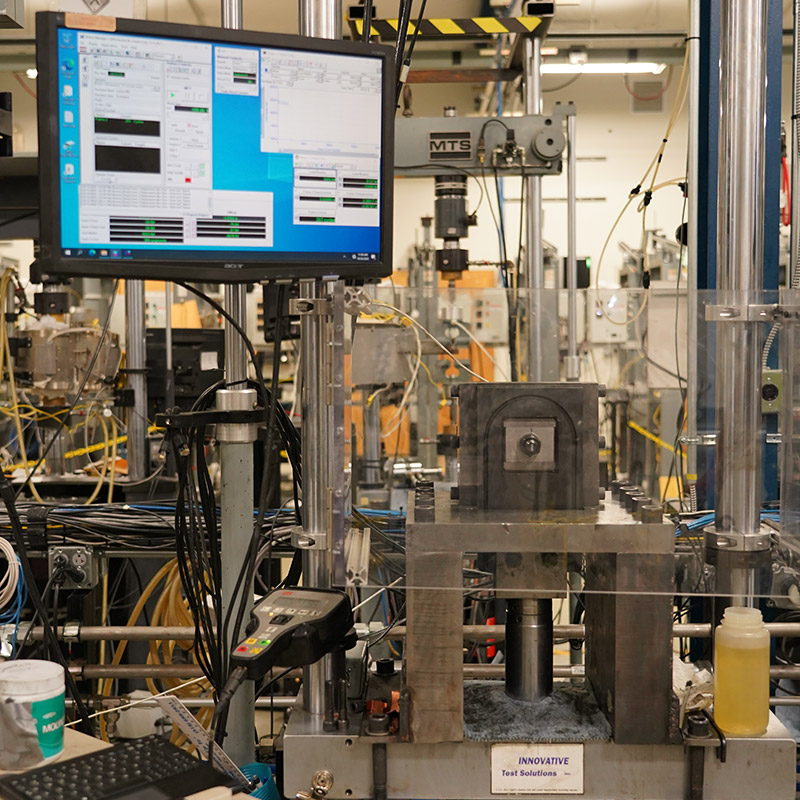
How Junker Testing Works
Junker testing is one of several types of mechanical testing services designed to evaluate components’ behavior when subjected to stress cycles. It can be used on various materials, components, and machinery in industries such as automotive, aerospace, and industrial.
Loading the Testing Equipment for Baseline Testing
Each baseline test must unload a minimum of 80% between 200 and 400 cycles for at least three baseline tests.
Conducting Verification Testing
During the verification testing, components are subjected to alternating tensile and compressive forces at an average of 12 Hertz (Hz) for 2,000 cycles.
Confirming the Results
Junker vibration tests require an average of 12 verification tests to validate and confirm displacement consistently.
Reviewing the Data
ITS engineers review the data and confer with clients before ultimately providing a Certificate of Test with all pertinent details.
Key Benefits of Mechanical Testing
Junker testing provides critical insight into how fasteners and mechanical joints perform under vibration and dynamic loading. By simulating real-world operational stress, this testing helps manufacturers validate joint integrity, improve reliability, and prevent loosening-related failures before components are placed into service.
- Confirms fastener durability under vibration
- Evaluates long-term joint reliability
- Identifies loosening and fatigue-related weaknesses
- Supports early design and joint optimization
- Assesses fatigue strength and cycle endurance
- Improves safety and reduces unplanned downtime
Frequently Asked Questions
How many fasteners are used for a Junker test?
Junker tests require a minimum of three baseline tests, each with a new set of hardware. The process then moves to 12 or more rounds of verification testing, each with fresh fasteners.
How is self-loosening behavior determined?
In Junker testing, a component or material is subjected to alternating tensile and compressive forces in a controlled environment. By applying dynamic shear loading to the joint, it’s possible to simulate transverse vibration like the sample would encounter during normal operations. These forces are applied at specific frequencies to simulate the type of loading that occurs during the product’s lifetime, with engineers measuring the number of cycles it takes for the joint to fail.
Why is it named Junker?
It’s named after Gerhard H. Junker, who pioneered this testing method. In 1969, Junker published the “New Criteria for Self-loosening of Fasteners Under Vibration” after conducting research into the effects of transverse loads on bolted joints. It is standardized by the highly respected German Institute for Standardization. ITS is ISO/IEC 17025 accredited to conduct DIN 25201-4 Junker testing, the most updated and rigorous version of the test.
What size range are you able to test in?
ITS can accommodate bolt sizes as small as 0.078 inches and as large as 2 inches in diameter. For options outside of that range, call to speak with one of our engineers. We also specialize in building custom rigs. The team will work with you to understand the objective and create a solution that aligns with your needs.
How long does Junker testing typically take?
Most Junker tests take anywhere from several hours to several days. The length of time depends on the complexity of the materials and testing conditions.
Client Testimonials
Nick Kattamis – Creare
I wanted to extend a very big THANK YOU for prioritizing this work and helping it get done so quickly. Often times these last minute requests are out of our hands, so again, thank you for your responsiveness.
Ryan Canfield
I’d like to thank Innovative Test Solutions for their excellent work, and for accommodating our second round of testing. This was an important milestone for us, and we will definitely remember you for future needs.
Kris – GE Power
Excellent work on this testing and report write up! As usual, the ITS team exceeded expectations.
Earl Size
Thank you very much! And thank you for going the extra mile in helping us where you thought to. I truly appreciate it.
Richard F. – Chromalloy
The efforts on the erosion test program were excellent. Kyle and Jason did an outstanding job. We were working with many unknowns. Both men made major contributions that resulted in a successful outcome. I now feel confident that we have the recipe to conduct side-by-side erosion tests of coatings on actual parts. I anticipate that we will use the erosion test methodology again in the latter part of 2019. Thanks for your assistance.
Adam – Curtiss Wright
Thank you all for all of your efforts with this program. I have worked with many test labs over the years and must say that you were one of the best I have come across. The responsiveness and willingness to work with us to find a good solution was unprecedented with previous experiences with other facilities. Thank you all for being great to work with.
Recent Posts

How Fatigue Testing Can Prevent Costly Failures in Critical Industries
Fatigue testing does so much more than simply predict product failure. It also helps refine designs and provide valuable insight into material properties and behaviors to support safety and reliability. Many industries rely on rigorous…

Exploring JETS Testing: Key to Aerospace Safety and Efficiency
Exploring JETS Testing: Key to Aerospace Safety and Efficiency The aerospace industry solves some of the most complex issues faced by modern society. This sector has always pushed beyond the limits of what is possible…

High-Cycle Fatigue vs. Low-Cycle Fatigue Testing
Introduction to Fatigue Testing Fatigue refers to the gradual formation of microcracks and cracks in a material under the cyclic loading of stress. Those irregularities reduce the material’s capacity to withstand cyclic loads and ultimately lead…
Speak With A Professional Today
Make an Inquiry or Request a Quote and our team will be in touch.