

What is Sub-Miniature Creep Testing?
Sub-miniature creep testing is a specialized mechanical test used to evaluate creep deformation and time to rupture using small scale specimens. It is used when material availability is limited, component extraction is required, or full-size creep specimens cannot be produced.
This testing method applies a sustained tensile load at elevated temperature to sub-miniature specimens while measuring strain accumulation and rupture behavior over time. The results provide insight into long term material performance, creep resistance, and degradation under service like conditions.
Sub-miniature creep testing is commonly applied to service exposed components, and legacy materials. Typical industries include aerospace, power generation, petrochemical, nuclear, defense, and industrial process equipment where remaining life assessment and localized material evaluation are required.
How Sub-Miniature Creep Testing Works
Specimen Extraction and Preparation
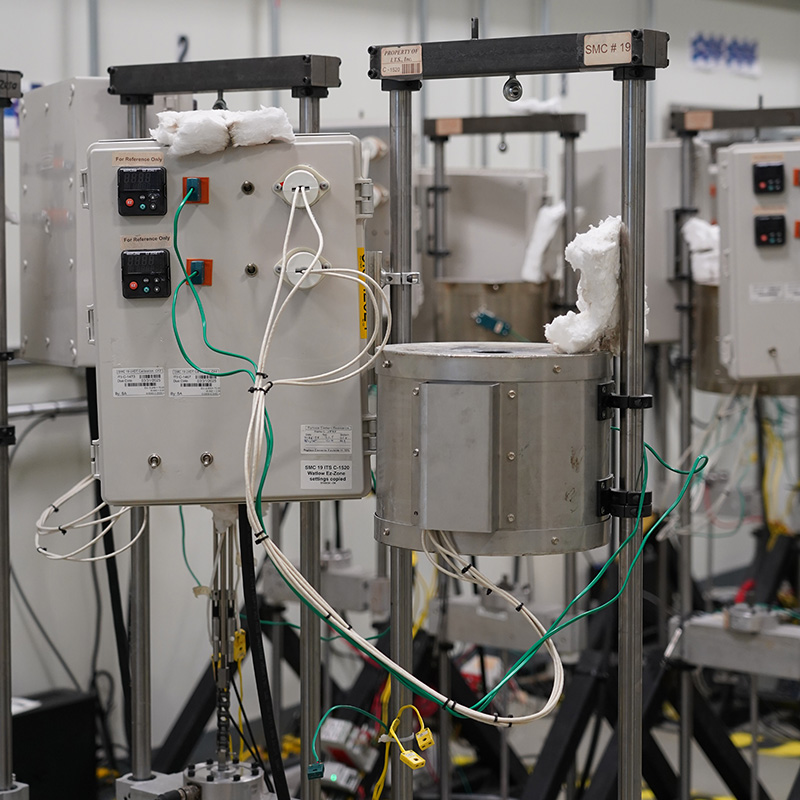
Sub-miniature specimens are extracted from components or prepared from limited material stock using precision machining methods. Geometry is tightly controlled to ensure repeatability. Specimens are measured, documented, and installed in creep frames designed for low load and small cross section testing.
Sustained Load and Temperature Exposure
A constant tensile load is applied while the specimen is maintained at a controlled elevated temperature. Strain, elongation, time, and temperature are continuously monitored throughout the test. Tests may run for extended durations to capture primary, secondary, and tertiary creep behavior.
Data Interpretation and Reporting
Creep strain curves, rupture time, and deformation rates are analyzed after testing. A detailed report documents test conditions, and resulting data.
Key Benefits of Sub-Miniature Creep Testing
Sub-miniature creep testing enables long term creep evaluation when material quantity is limited or component preservation is required. It supports informed engineering decisions without the need for full size specimen removal.
- Enables creep testing with minimal material removal
- Supports remaining life and service exposure assessment
- Evaluates localized regions such as welds or heat affected zones
- Supports research and development of advanced and legacy materials
Frequently Asked Questions
When should sub-miniature creep testing be used instead of standard creep testing?
Sub-miniature creep testing is used when full size creep specimens cannot be obtained due to limited material availability, component geometry, or service constraints. Common use cases include in service components, weld evaluations, and legacy equipment. This approach allows engineers to obtain creep behavior data while preserving structural integrity and minimizing material removal.
What specimen sizes are used in sub-miniature creep testing?
Sub-miniature creep specimens are significantly smaller than standard creep bars and are machined to specialized geometries suited for low load creep frames. Dimensions depend on available material, extraction location, and test objectives. Maintaining consistent geometry is critical for repeatable and interpretable results.
What challenges are associated with sub-miniature creep testing?
Challenges include precise specimen machining, accurate strain measurement, alignment sensitivity, and strict temperature control. Because of the small specimen size, minor variations can affect results. These challenges are addressed through specialized fixturing, calibration, and controlled test procedures.
How are sub-miniature creep testing results used in engineering decisions?
Results are used to support remaining life assessments, evaluate service degradation, compare material conditions, and guide repair or replacement decisions. Sub-miniature creep testing is also valuable for weld assessment, and localized material characterization when conventional creep testing is not feasible.
Client Testimonials
Nick Kattamis – Creare
I wanted to extend a very big THANK YOU for prioritizing this work and helping it get done so quickly. Often times these last minute requests are out of our hands, so again, thank you for your responsiveness.
Ryan Canfield
I’d like to thank Innovative Test Solutions for their excellent work, and for accommodating our second round of testing. This was an important milestone for us, and we will definitely remember you for future needs.
Kris – GE Power
Excellent work on this testing and report write up! As usual, the ITS team exceeded expectations.
Earl Size
Thank you very much! And thank you for going the extra mile in helping us where you thought to. I truly appreciate it.
Richard F. – Chromalloy
The efforts on the erosion test program were excellent. Kyle and Jason did an outstanding job. We were working with many unknowns. Both men made major contributions that resulted in a successful outcome. I now feel confident that we have the recipe to conduct side-by-side erosion tests of coatings on actual parts. I anticipate that we will use the erosion test methodology again in the latter part of 2019. Thanks for your assistance.
Adam – Curtiss Wright
Thank you all for all of your efforts with this program. I have worked with many test labs over the years and must say that you were one of the best I have come across. The responsiveness and willingness to work with us to find a good solution was unprecedented with previous experiences with other facilities. Thank you all for being great to work with.
Recent Posts

How Fatigue Testing Can Prevent Costly Failures in Critical Industries
Fatigue testing does so much more than simply predict product failure. It also helps refine designs and provide valuable insight into material properties and behaviors to support safety and reliability. Many industries rely on rigorous…

Exploring JETS Testing: Key to Aerospace Safety and Efficiency
Exploring JETS Testing: Key to Aerospace Safety and Efficiency The aerospace industry solves some of the most complex issues faced by modern society. This sector has always pushed beyond the limits of what is possible…

High-Cycle Fatigue vs. Low-Cycle Fatigue Testing
Introduction to Fatigue Testing Fatigue refers to the gradual formation of microcracks and cracks in a material under the cyclic loading of stress. Those irregularities reduce the material’s capacity to withstand cyclic loads and ultimately lead…
Speak With A Professional Today
Make an Inquiry or Request a Quote and our team will be in touch.